Building Code
Locally adopted International Building Code (editions vary; many major cities on 2021 IBC, others on 2018 or 2015)
Texas · Licensed Professional Engineering
Coordinated mechanical, electrical, and plumbing design — engineered as one system, stamped by licensed professionals, and documented for fast permit approval.
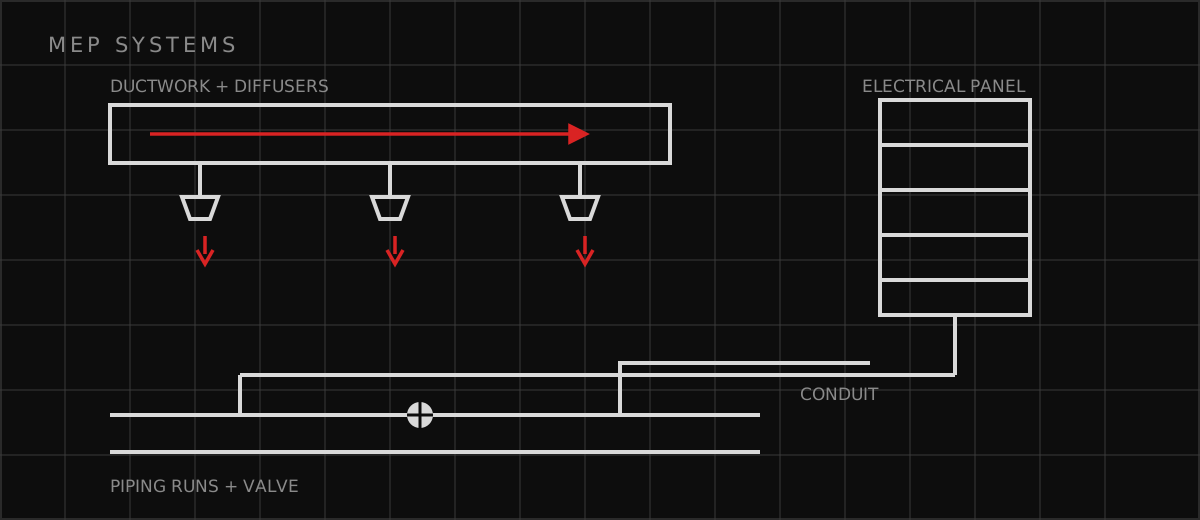
Permit stuck waiting on a seal? Apex Grid's licensed engineers provide fast MEP review-and-seal for drawings in Texas and across the state — reviewed under responsible charge and sealed for submittal to the applicable Texas permitting authority. Typical turnaround is 3–5 business days once we have a complete package.
MEP design in Texas is a humidity and reliability problem before it is a temperature problem. On the Gulf Coast — Houston, Corpus Christi, and the climate zone 2A belt — latent load often dominates, so we design dehumidification and reheat strategies that keep spaces comfortable without over-cooling, and we detail vapor control carefully because envelope condensation is a real failure mode in mixed-humid Texas. Winter Storm Uri reset expectations for electrical resilience: we increasingly specify freeze protection, standby power, and load-shed schemes so buildings ride through grid stress on the ERCOT system. Because the 2021 IECC is the commercial baseline, our HVAC and lighting designs carry compliance documentation matched to that edition, with ASHRAE 90.1 as an alternate path where a city prefers it. Equipment is sized to 100°F+ design days with the long cooling seasons that define nearly every Texas market.
Code adoptions change on multi-year cycles and many states allow local amendments. The researched source verification date is 2026-07-28; we verify the governing edition with your permitting jurisdiction at project kickoff.
Permitting varies dramatically by jurisdiction: Houston famously has no zoning but enforces strict floodplain and drainage criteria, while Dallas and Austin run structured plan-review with published amendment packages. Coastal counties add windstorm (TDI/TWIA) inspection and certification requirements that must be planned into the schedule.
Texas offers licensure by reciprocity for qualified out-of-state PEs and requires firms to hold a Certificate of Registration. Digital/electronic seals are accepted on submittals per board rules.
Texas leads the nation in construction volume, driven by relentless population growth, corporate relocations to DFW and Austin, Gulf Coast petrochemical and LNG expansion, and a booming data-center and semiconductor pipeline. Warehouse/industrial and multifamily starts remain strong across the major metros.
Key markets: Houston, Dallas–Fort Worth, San Antonio, Austin, El Paso, Corpus Christi.
Our highest-demand markets for mep engineering in Texas.
For projects whose jurisdiction, discipline, and scope pass review, an available licensed PE and coordinated team can be identified. Send us your scope for a proposal; timing and fee depend on the project.
Request a ProposalReviewed and sealed by licensed PEs. “Solid engineering and clear communication from start to finish.” — Jason Mitchell, Principal Architect
Tell us what you need and where the project is — quotes back within 12–24 hours on qualifying scopes.