Building Code
Nebraska State Building Code based on the IBC (default statewide; local jurisdictions may adopt and amend)
Nebraska · Licensed Professional Engineering
Coordinated mechanical, electrical, and plumbing design — engineered as one system, stamped by licensed professionals, and documented for fast permit approval.
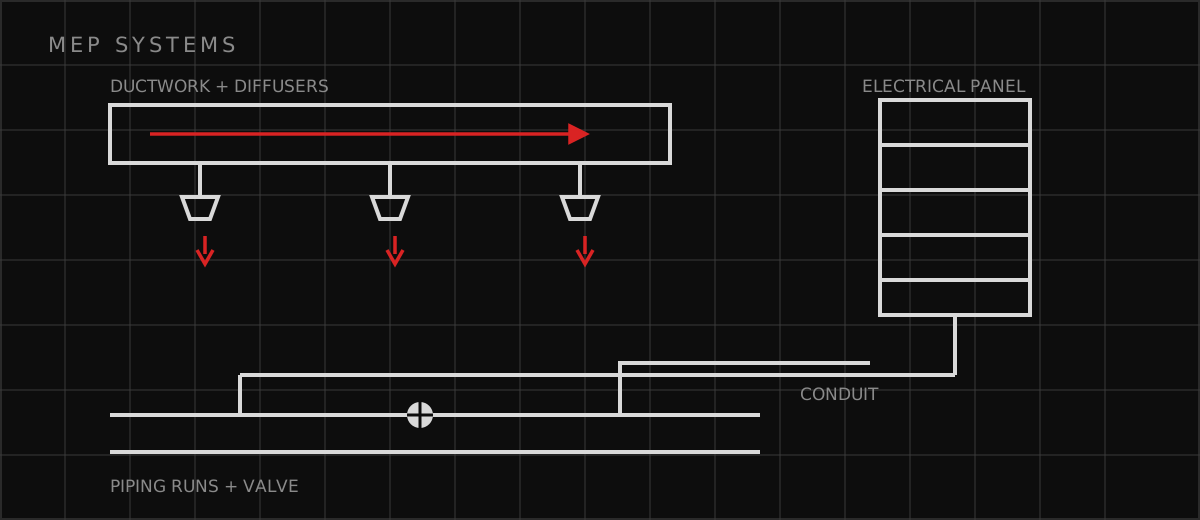
Permit stuck waiting on a seal? Apex Grid's licensed engineers provide fast MEP review-and-seal for drawings in Nebraska and across the state — reviewed under responsible charge and sealed for submittal to the applicable Nebraska permitting authority. Typical turnaround is 3–5 business days once we have a complete package.
Nebraska's continental climate — cold winters and hot summers across zones 5A in the east and 5B in the drier west — shapes a mechanical strategy that is heating-forward but adaptable. With substantial winter demand, we weigh cold-climate heat pumps, VRF, and condensing boilers against one another, detailing thorough freeze protection, then tailor the summer side — full cooling and dehumidification in the humid east, or economizer and evaporative approaches out in the drier west. Nebraska's standout MEP story is its data-center boom: reliable, low-cost power from public utilities like OPPD and the Nebraska Public Power District has drawn large hyperscale and colocation projects, and these facilities drive some of the region's largest cooling and electrical loads, demanding careful redundancy, service sizing, and utility coordination. Because Nebraska adopts a statewide energy code, our mechanical and lighting compliance is uniform even where building-code enforcement is local, though we design above the minimum to control heating cost.
Code adoptions change on multi-year cycles and many states allow local amendments. The researched source verification date is 2026-07-28; we verify the governing edition with your permitting jurisdiction at project kickoff.
Nebraska's State Building Code provides a baseline, but enforcement is local: Omaha and Lincoln run structured commercial review with their own amendments and editions, while smaller and rural jurisdictions vary and some have limited enforcement. The statewide energy code applies broadly, but building-code edition and review process should be confirmed with the specific AHJ.
Nebraska grants licensure by comity for NCEES-record engineers; electronic seals and digital signatures are accepted for plan submittals under board rules.
Nebraska's construction market is anchored by data centers (drawn to Omaha and eastern Nebraska by reliable, low-cost public power), agricultural processing, insurance and finance in Omaha, and logistics along the I-80 corridor. Healthcare and higher-education construction remain steady in the Omaha and Lincoln metros.
Key markets: Omaha, Lincoln, Bellevue, Grand Island, Kearney, Fremont.
Our highest-demand markets for mep engineering in Nebraska.
For projects whose jurisdiction, discipline, and scope pass review, an available licensed PE and coordinated team can be identified. Send us your scope for a proposal; timing and fee depend on the project.
Request a ProposalReviewed and sealed by licensed PEs. “Solid engineering and clear communication from start to finish.” — Jason Mitchell, Principal Architect
Tell us what you need and where the project is — quotes back within 12–24 hours on qualifying scopes.