Building Code
Local adoption of the International Building Code (most jurisdictions on 2018 IBC)
Nevada · Licensed Professional Engineering
Structural systems designed to the loads your state actually imposes — gravity, seismic, wind, and snow — with drawings built to get approved the first time.
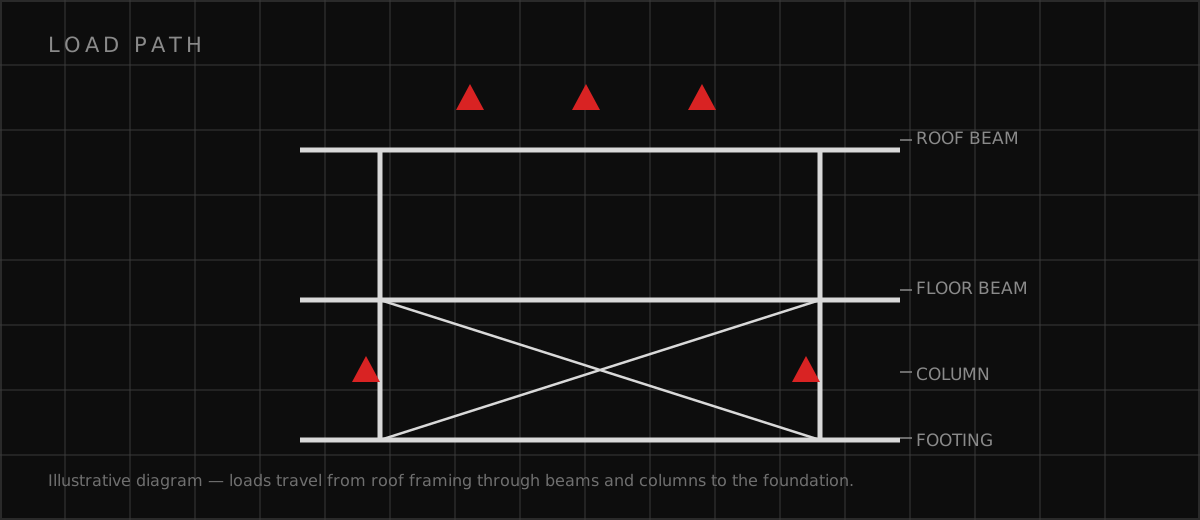
Permit stuck waiting on a seal? Apex Grid's licensed engineers provide fast Structural review-and-seal for drawings in Nevada and across the state — reviewed under responsible charge and sealed for submittal to the applicable Nevada permitting authority. Typical turnaround is 3–5 business days once we have a complete package.
Structural priorities in Nevada shift with latitude. Western Nevada around Reno lies in an active seismic belt where SDC D is common, so we detail ductile lateral systems and coordinate site response with the geotechnical engineer, while southern Nevada's lower-but-not-trivial seismicity still requires proper detailing on essential facilities. Southern Nevada's real challenge is often below grade: collapsible and gypsiferous soils plus hard caliche layers complicate excavation and foundation design, and mitigation such as overexcavation, moisture conditioning, or deepened footings is driven by the geotechnical report. Mountain-front and Sierra-adjacent projects add ground snow loads that grow with elevation, so we confirm the governing IBC edition per jurisdiction and combine snow, seismic, and wind demands appropriately.
Code adoptions change on multi-year cycles and many states allow local amendments. The researched source verification date is 2026-07-28; we verify the governing edition with your permitting jurisdiction at project kickoff.
Clark County and the City of Las Vegas dominate southern Nevada permitting and enforce aggressively on drainage and dust in a fast-growth environment; Reno and Washoe County govern the north with added seismic scrutiny. Regional flood-control districts (notably the Clark County Regional Flood Control District) impose their own hydrology criteria on site design.
Nevada offers licensure by comity for qualified out-of-state PEs and accepts electronic seals for digital submittals. Discipline-specific registration applies.
Nevada's construction market is anchored by the massive warehouse, logistics, and data-center corridor around the Reno-Sparks Tahoe-Reno Industrial Center, alongside continued gaming, hospitality, and healthcare expansion in Las Vegas. Advanced manufacturing near Reno and Southern Nevada population growth keep demand for MEP and site engineering strong.
Key markets: Las Vegas, Henderson, Reno, North Las Vegas, Sparks, Carson City.
Our highest-demand markets for structural engineering in Nevada.
For projects whose jurisdiction, discipline, and scope pass review, an available licensed PE and coordinated team can be identified. Send us your scope for a proposal; timing and fee depend on the project.
Request a ProposalReviewed and sealed by licensed PEs. “Solid engineering and clear communication from start to finish.” — Jason Mitchell, Principal Architect
Tell us what you need and where the project is — quotes back within 12–24 hours on qualifying scopes.