Building Code
No statewide commercial building code — local adoption of the IBC
Missouri · Licensed Professional Engineering
Structural systems designed to the loads your state actually imposes — gravity, seismic, wind, and snow — with drawings built to get approved the first time.
Permit stuck waiting on a seal? Apex Grid's licensed engineers provide fast Structural review-and-seal for drawings in Missouri and across the state — reviewed under responsible charge and sealed for submittal to the applicable Missouri permitting authority. Typical turnaround is 3–5 business days once we have a complete package.
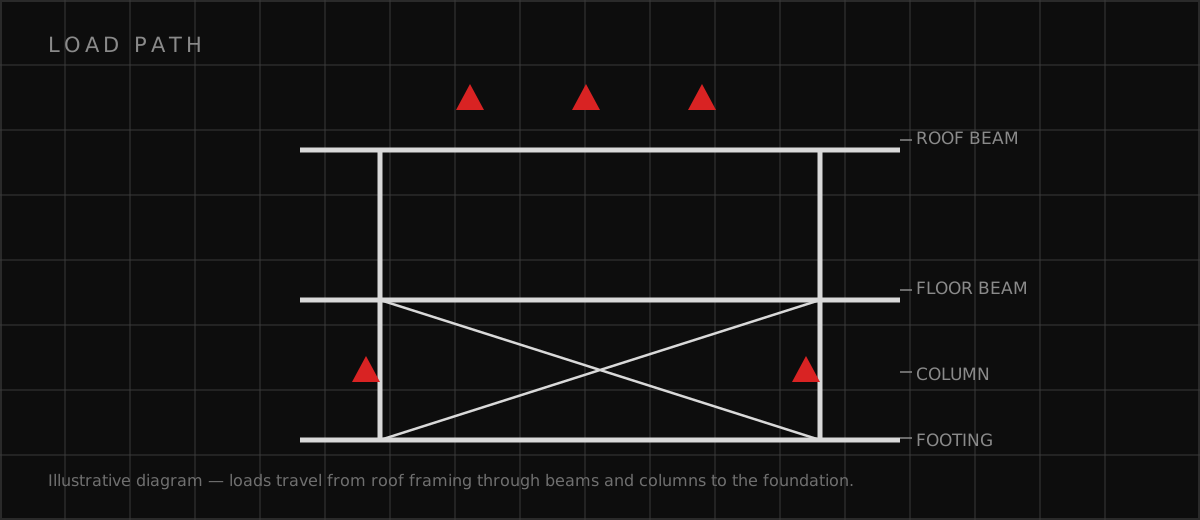
Missouri structural design is bifurcated by seismicity. Across most of the state — Kansas City, St. Louis, Springfield — demand is low (SDC A–B) and wind and gravity govern, with Missouri's frequent tornadoes keeping our uplift resistance and load-path continuity rigorous. But southeastern Missouri, the Bootheel near the New Madrid Seismic Zone, carries some of the highest seismic demand east of the Rockies, reaching SDC D or higher, where ductile detailing, careful lateral design, and attention to liquefiable alluvial soils are non-negotiable. Ground snow is a light load here, near 15–20 psf, while footings reach past the roughly 30-to-36-inch frost depth. Statewide expansive clays and soft soils along the river corridors call for close geotechnical coordination. With no building code enacted at the state level, we tie the governing IBC edition to the specific AHJ and design the gravity and lateral systems to both that basis and the site's actual seismic category.
Code adoptions change on multi-year cycles and many states allow local amendments. The researched source verification date is 2026-07-28; we verify the governing edition with your permitting jurisdiction at project kickoff.
Missouri's home-rule structure means permitting is entirely local. Kansas City and St. Louis run structured commercial review with their own amendments and editions, while suburban and rural jurisdictions vary widely — some with minimal review. Confirming the governing code, edition, and energy requirements with the specific AHJ is the essential first step on any Missouri project.
Missouri grants licensure by comity for NCEES-record engineers; electronic seals and digital signatures are accepted for plan submittals under board rules.
Missouri's two major metros anchor the market: Kansas City is a national logistics and animal-health/agtech hub with heavy warehouse and data-center growth, while St. Louis sustains healthcare, higher education, geospatial/defense, and biotech development. Springfield and the I-44 corridor add manufacturing and distribution activity.
Key markets: Kansas City, St. Louis, Springfield, Columbia, Independence, Lee's Summit.
Our highest-demand markets for structural engineering in Missouri.
For projects whose jurisdiction, discipline, and scope pass review, an available licensed PE and coordinated team can be identified. Send us your scope for a proposal; timing and fee depend on the project.
Request a ProposalReviewed and sealed by licensed PEs. “Solid engineering and clear communication from start to finish.” — Jason Mitchell, Principal Architect
Tell us what you need and where the project is — quotes back within 12–24 hours on qualifying scopes.