Building Code
No statewide commercial building code — local adoption of the IBC
Kansas · Licensed Professional Engineering
Energy compliance handled as engineering, not paperwork — documentation matched to the exact code edition your permitting jurisdiction enforces.
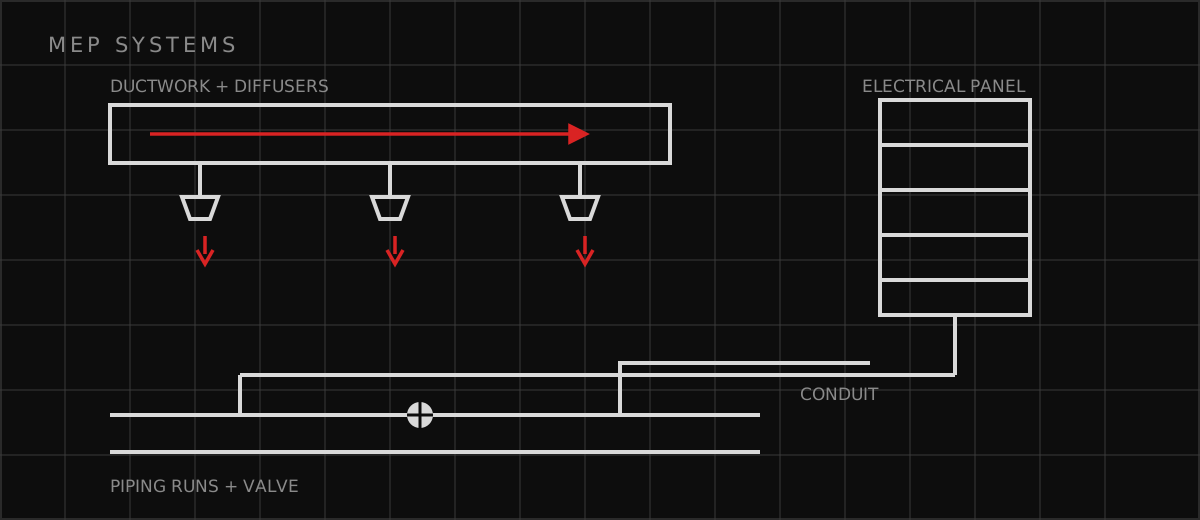
Permit stuck waiting on a seal? Apex Grid's licensed engineers provide fast Energy review-and-seal for drawings in Kansas and across the state — reviewed under responsible charge and sealed for submittal to the applicable Kansas permitting authority. Typical turnaround is 3–5 business days once we have a complete package.
Because Kansas sets no energy code statewide, commercial compliance becomes a mapping problem: larger cities run their own IECC editions on separate schedules, while some rural jurisdictions enforce none. We document against whatever edition the permitting authority actually uses and steer clients away from the costly mistake of designing to a cycle that doesn't apply. Across the zone 4A territory that covers most of the state, heating and cooling matter about equally, so we tune insulation, air tightness, and glazing SHGC as one package and size mechanical plants for that balanced load. Toward the drier west, solar-heat-gain control and cooling strategy gain weight. We also surface Evergy incentives for above-code performance, which can recover first cost where the local minimum is thin or missing.
Code adoptions change on multi-year cycles and many states allow local amendments. The researched source verification date is 2026-07-28; we verify the governing edition with your permitting jurisdiction at project kickoff.
Kansas permitting is local: Johnson County suburbs (Overland Park, Olathe), Wichita, and Topeka run structured commercial review with their own amendments and editions, while rural jurisdictions vary widely and some have minimal review. Confirming the governing code, edition, and energy requirements with the specific AHJ is the essential first step on any Kansas project.
Kansas grants licensure by comity/endorsement for NCEES-record engineers; electronic seals and digital signatures are accepted for plan submittals under board rules.
Kansas' construction market is anchored by aerospace and advanced manufacturing in Wichita (a global aviation hub), logistics and corporate development in the Johnson County/Kansas City suburbs, and agricultural processing and wind-energy infrastructure statewide. Data-center and distribution growth is expanding along the eastern corridors.
Key markets: Wichita, Overland Park, Kansas City (KS), Topeka, Olathe, Lawrence.
Our highest-demand markets for energy engineering in Kansas.
For projects whose jurisdiction, discipline, and scope pass review, an available licensed PE and coordinated team can be identified. Send us your scope for a proposal; timing and fee depend on the project.
Request a ProposalReviewed and sealed by licensed PEs. “Solid engineering and clear communication from start to finish.” — Jason Mitchell, Principal Architect
Tell us what you need and where the project is — quotes back within 12–24 hours on qualifying scopes.