STRUCTURAL ENGINEERING • ALBANY
Albany Structural Engineering for Civic, Institutional, and Mixed-Use Work
Albany projects sit at the meeting point of state government, older urban fabric, river and creek flood risk, and active institutional campuses. We investigate the actual structure and develop a scoped solution for the City of Albany Department of Buildings and Regulatory Compliance and other applicable reviewers.
Permit authority
The City of Albany Department of Buildings and Regulatory Compliance handles local building permits, with Planning, zoning, historic preservation, and county or state agencies adding review as applicable. State-owned work may follow an owner or Office of General Services process rather than a simple city permit; jurisdiction must be confirmed at project initiation.
Code context
The NYS Uniform Code and Energy Code govern most Albany construction, together with City zoning, local procedures, historic-district review, and project-owner standards. The team verifies whether state ownership, public work, existing-building alterations, or special inspections changes the submission and code path.
Local conditions
Albany has freeze-thaw weather, winter snow, river and urban flood exposure, variable alluvial and glacial soils, and a substantial inventory of masonry, timber, and institutional buildings. Differential settlement, moisture, corrosion, and vibration from occupied civic facilities may govern more than nominal member strength.
Typical project types
Capitol-area office renovations, brownfield and riverfront redevelopment, university work, historic row buildings, schools, healthcare facilities, and mixed-use infill.
Public-building continuity shapes structural sequencing
A state office, courthouse, hospital, or campus building may need uninterrupted egress, security, records, and operations while framing is altered. We separate permanent design from temporary support and coordinate observation windows, access controls, vibration limits, and protection with the owner’s facility team.
Historic masonry needs a compatible intervention
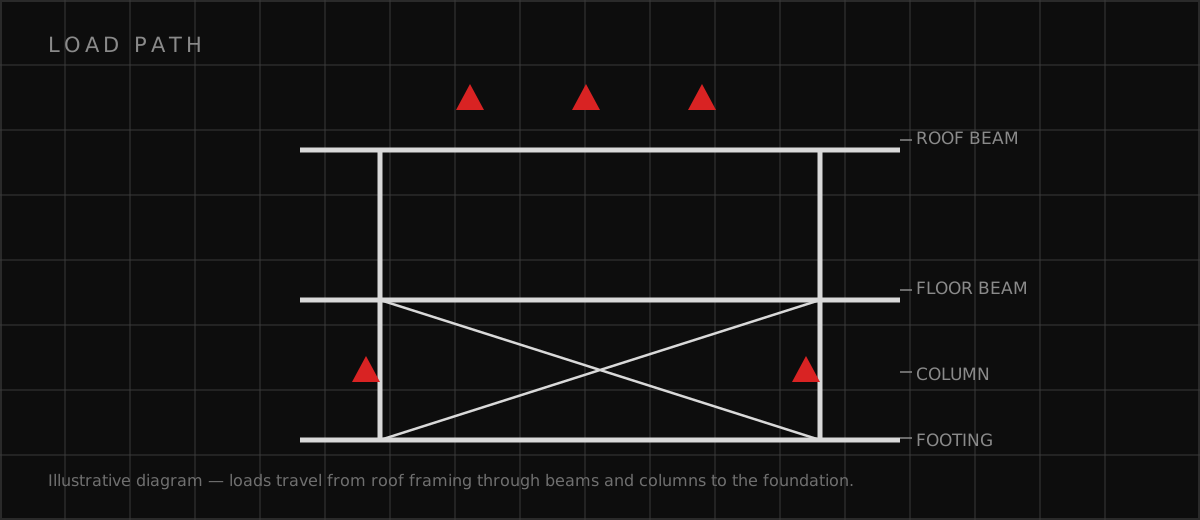
Albany’s older buildings often pair load-bearing masonry with timber or steel that has seen moisture and piecemeal alterations. Repair design addresses load path, repointing, flashing, connection corrosion, and the preservation review context rather than simply inserting a modern frame.
Flood and foundation decisions belong together
River-adjacent or low-lying sites may face groundwater, flood elevation, scour, and saturated fills. Foundation selection, buoyancy, equipment elevation, temporary excavation, and water management should be evaluated as a connected risk picture with geotechnical input.
Private and state review leave different paper trails
A private Albany filing may travel through Buildings & Regulatory Compliance and Planning & Development, while state-owned work can follow OGS or an agency review. We label the structural basis, special inspections, and responses for the authority that can actually accept the work.
Permit and engineering steps
- Determine whether the project belongs in Albany Buildings & Regulatory Compliance, an OGS/state-owner review, or an institutional process; record ownership, occupancy, zoning, preservation, flood exposure, and applicant responsibility.
- Use archives, probes, foundation and roof observations, geotechnical information, and facilities interviews to separate state-owner standards from the existing structure actually available for alteration.
- Prepare the NYS-code basis, calculations, structural sheets, TR1 or equivalent inspection schedule, and phasing narrative in the format required by the selected authority.
- Route private work through Albany’s permit intake and Planning & Development referrals, or state work through its owner portal; reconcile preservation, fire, flood, and utility comments by authority.
- Maintain observation reports, concealed-condition directives, material tests, approved change sketches, and the final inspection or owner acceptance record.
Albany Structural Engineering for Civic, Institutional, and Mixed-Use Work FAQs
Does Albany Buildings & Regulatory Compliance review every state-owned project?
Are Albany historic buildings safe to strengthen with modern details?
Why is geotechnical information important near the Hudson?
Official sources
These official sources support the local permit, code, utility, climate, and environmental context. The current AHJ and adopted requirements control.
Discuss your Albany scope
Send the address, existing records, proposed use, authority correspondence, and requested deliverable. Responsible professional review and availability are confirmed before work begins.
Request a Project Review