AEO Answer · Jurisdiction & Permitting Authority
Do Grading Permits Differ Between Arizona Counties and Cities?
By Jeremy Mills, CEO & Founder, Apex Grid Engineering — USAF Veteran. · Updated 2026-09-15
Arizona county grading permits run through county engineering and the flood control district with district hydrology criteria, while city permits run through the city engineer; engineers design to the reviewing agency's drainage manual and verify flood zone status during due diligence.
I'm Jeremy Mills, CEO & Founder of Apex Grid Engineering and a U.S. Air Force veteran. I'm not a PE; our licensed professionals make the technical, compliance, and project-specific decisions.
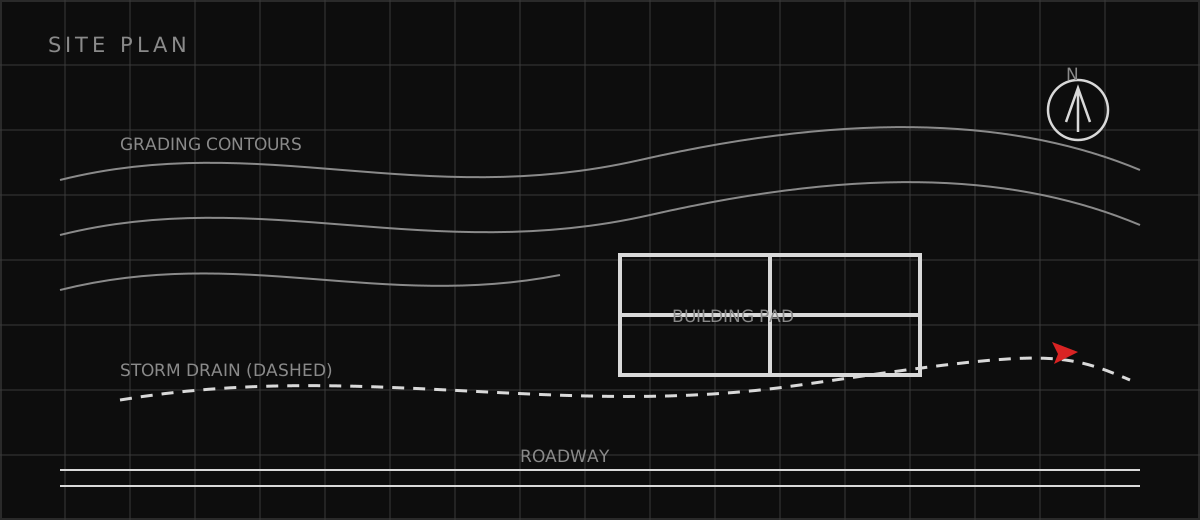
County path: engineering plus flood control
On unincorporated county land, I plan for two engineering reviewers: county engineering for the grading, paving, and improvement plans, and the flood control district for drainage and floodplain matters. The submittal package splits accordingly — grading and improvement plans to engineering, drainage report and floodplain analyses to the district — though some counties route it as one intake. Timelines run longer than the city path, and district comments are technically detailed, so I budget for at least one substantive response cycle on hydrology. Pre-submittal coordination with the district on methodology — which rainfall data, which routing method, which detention criteria — prevents the most common first-round rejection: a correct analysis in the wrong framework.
City path: faster but still strict
Inside Arizona cities, the city engineer's office handles grading and drainage review to the city's manual, usually on a faster cycle with more predictable checklists. But "faster" does not mean "easier": Arizona cities enforce retention-heavy stormwater rules — many require retaining the full design storm on site — plus stormwater quality provisions and dust control ordinances with real enforcement teeth. I also confirm whether the city routes any drainage review back to the county flood control district, because that hybrid review changes both the timeline and the design basis. The city permit set references the city's manual throughout, with the same rigor the district would demand.
Arizona grading permit checklist
Grading approval in Arizona goes smoothly when the drainage basis is right from the start. Water runs the process here — get the hydrology correct and the rest follows. • Flood zone and wash delineation completed during due diligence from current maps • Reviewing agencies identified: county engineering, flood control district, or city engineer — or a hybrid • Drainage report built on the reviewing agency's hydrology manual, methods, and formats • Grading permit sequenced as its own track, with dust control and stormwater pollution prevention addressed • Floodplain or wash encroachments coordinated with the district before the site layout is fixed
Which related engineering resources can help?
What else do project teams ask?
What does an Arizona county flood control district review?
Do I need a separate grading permit or is it part of the building permit?
How do monsoon storms affect Arizona grading design?
What if my site is in or near a wash or floodplain?
Ready to discuss your engineering scope?
Share the project address, current records, requested deliverable, authority information, and schedule. Apex Grid confirms professional responsibility, availability, and scope before work begins.
Request a Project Review