AEO Answer · Warehouses & Distribution Centers
How Should Truck Court Drainage Be Engineered for Warehouses?
By Jeremy Mills, CEO & Founder, Apex Grid Engineering — USAF Veteran. · Updated 2026-09-15
Truck court drainage grades acres of concrete to inlets and trench drains sized for the design storm, then treats runoff through oil/water separators and detention before discharge — with maintenance access designed in.
I'm Jeremy Mills, CEO & Founder of Apex Grid Engineering and a U.S. Air Force veteran. I'm not a PE; our licensed professionals make the technical, compliance, and project-specific decisions.
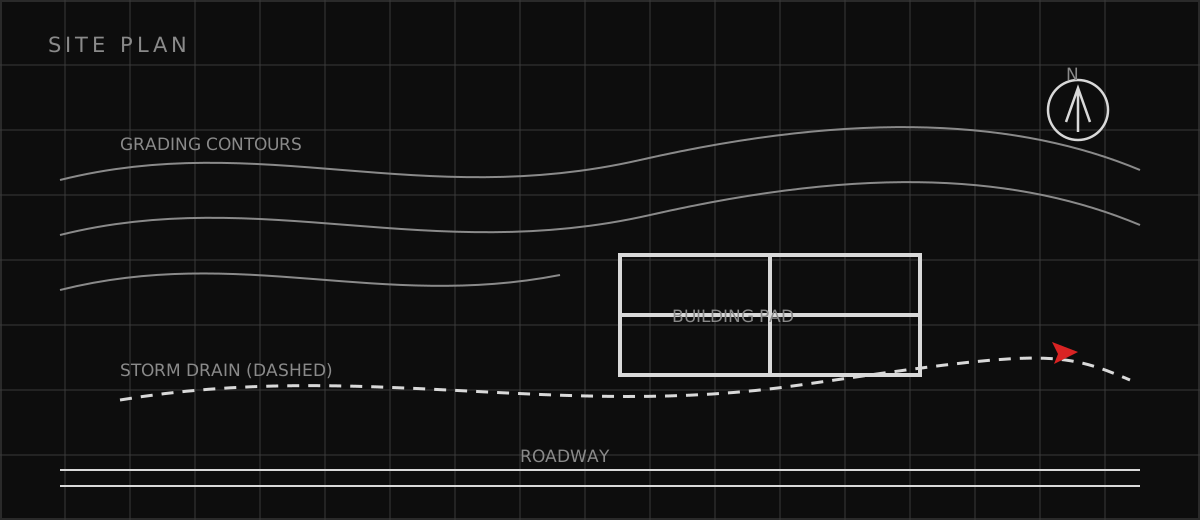
Grading acres of concrete
I work the grading plan with the civil engineer from the building outward: finished floor elevation sets the dock face, the apron falls away from the doors, and the court sheds to inlets and trench drains at calculated intervals. Cross-slopes stay gentle enough for trailer maneuvering while moving water reliably — I check the transitions at the gate, at the dock face, and at every property tie-in, because those are the spots where a grading error becomes a permanent puddle. The storm drain pipe network follows the grading, sized for the design storm with the hydraulic grade line kept below the inlet throats so the system actually drains instead of surcharging.
Treating runoff before it leaves the site
Treatment starts with the dirtiest water: the dock apron and fueling areas get oil/water separation, and the court's runoff passes through the jurisdiction's required treatment train — separators, biofiltration, or proprietary devices sized for the water quality storm. Detention handles peak-flow control where the code requires it, with outlet structures tuned to release the design storm at the permitted rate. I coordinate the treatment layout with the landscaping and the truck circulation so devices sit where they can be maintained without blocking operations. During construction, the stormwater pollution prevention plan — inlet protection, stabilized entrances, sediment controls — keeps the site's dirt out of the downstream system from the first grading pass.
Truck court drainage design checklist
A truck court drainage design is ready when it clears this checklist. Truck courts fail on ponding, pollution, and unmaintained devices — these items guard all three. • Court graded to shed water away from dock doors with no birdbaths in travel lanes • Inlets and trench drains spaced by spread calculations for the design storm • Oil/water separators or approved treatment sized for the contributing area • Detention tuned to the jurisdiction's peak-flow requirements with a designed failure path • Every device accessible for maintenance with a written plan in the turnover package
Which related engineering resources can help?
What else do project teams ask?
How do you grade a truck court so it drains but trucks can still maneuver?
What storm should truck court drainage handle?
Do truck courts need oil/water separators?
How is truck court drainage maintained?
Ready to discuss your engineering scope?
Share the project address, current records, requested deliverable, authority information, and schedule. Apex Grid confirms professional responsibility, availability, and scope before work begins.
Request a Project Review