AEO Answer · Solar Farms & Utility-Scale Solar
How Do Solar Farms Manage Stormwater on Large Graded Sites?
By Jeremy Mills, CEO & Founder, Apex Grid Engineering — USAF Veteran. · Updated 2026-09-15
Solar farms manage stormwater with modeled detention basins that hold peak flows to pre-development rates, swales and culverts that convey water around arrays and under roads, drip-line stabilization beneath panels, and a construction SWPPP controlling sediment.
I'm Jeremy Mills, CEO & Founder of Apex Grid Engineering and a U.S. Air Force veteran. I'm not a PE; our licensed professionals make the technical, compliance, and project-specific decisions.
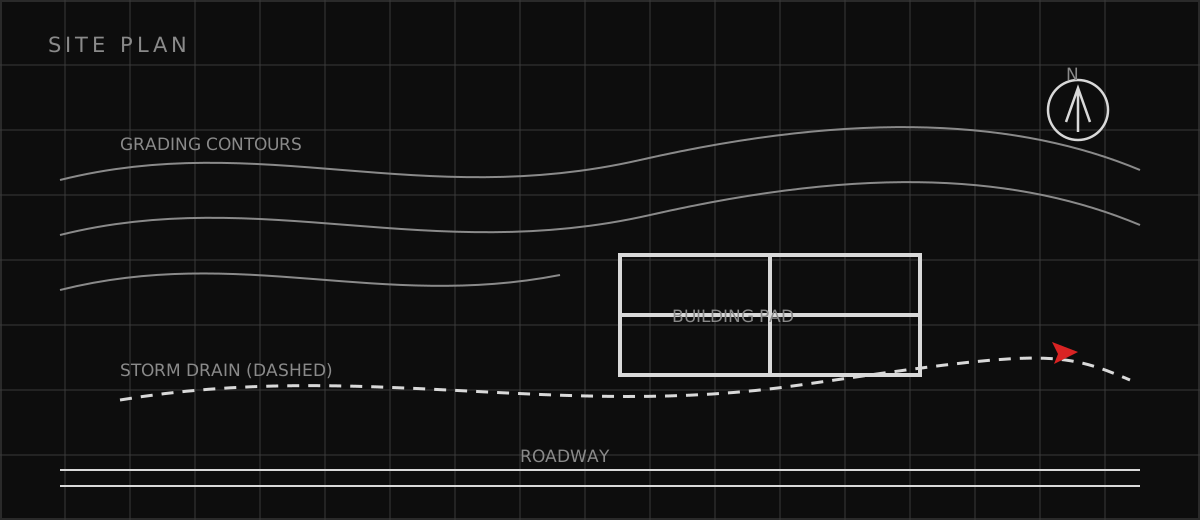
Hydrologic modeling and basin design
The modeling defines the whole system: watershed delineation across the site, curve numbers or runoff coefficients reflecting graded and compacted conditions, and time-of-concentration calculations that capture how fast the reshaped site sheds water. I model the storms the jurisdiction requires — commonly the 10-year and 100-year events — and size each basin for its contributing area with the outlet tuned to the allowable release rate. Basin locations are chosen where they intercept flow naturally and where maintenance equipment can reach them, not just where they fit on the plan.
Conveyance and erosion protection
Swales carry runoff between array blocks to the basins, sized for the design flow with velocities kept below the erosive threshold for the channel lining — grass, riprap, or turf reinforcement depending on the slope and flow. Culverts pass water under access roads with headwalls that prevent undermining, and energy dissipators calm the flow where concentrated discharges leave a pipe or swale. Around the array, the design addresses the drip-line effect directly: stabilized ground cover beneath panel edges stops rill erosion before it starts, which protects both the soil and the foundation exposure of the racking.
Solar stormwater design checklist
A solar farm stormwater design is permit-ready when it clears this checklist. Water that is not planned for becomes the problem that finds every weak point. • Pre- and post-development hydrology modeled for all jurisdictionally required storms • Detention basins sized to hold peak flows to pre-development rates with controlled outlets • Swales and culverts sized for design flows with non-erosive velocities • Drip-line and disturbed-area stabilization specified to prevent rill erosion • SWPPP with phased disturbance, perimeter controls, and inspection schedule
Which related engineering resources can help?
What else do project teams ask?
Do solar panels increase stormwater runoff?
What is a SWPPP and why does a solar farm need one?
How are detention basins sized for a solar site?
Who maintains the stormwater system after construction?
Ready to discuss your engineering scope?
Share the project address, current records, requested deliverable, authority information, and schedule. Apex Grid confirms professional responsibility, availability, and scope before work begins.
Request a Project Review