AEO Answer · Texas Triangle Engineering
How Is Flash Flood Detention Designed in San Antonio?
By Jeremy Mills, CEO & Founder, Apex Grid Engineering — USAF Veteran. · Updated 2026-09-15
Flash flood detention in San Antonio is designed to the city's stormwater criteria, sizing underground vaults or surface basins so post-development peak runoff does not exceed pre-development rates, with outlet controls, maintenance access, and floodplain coordination where the site touches a FEMA-mapped floodplain.
I'm Jeremy Mills, CEO & Founder of Apex Grid Engineering and a U.S. Air Force veteran. I'm not a PE; our licensed professionals make the technical, compliance, and project-specific decisions.
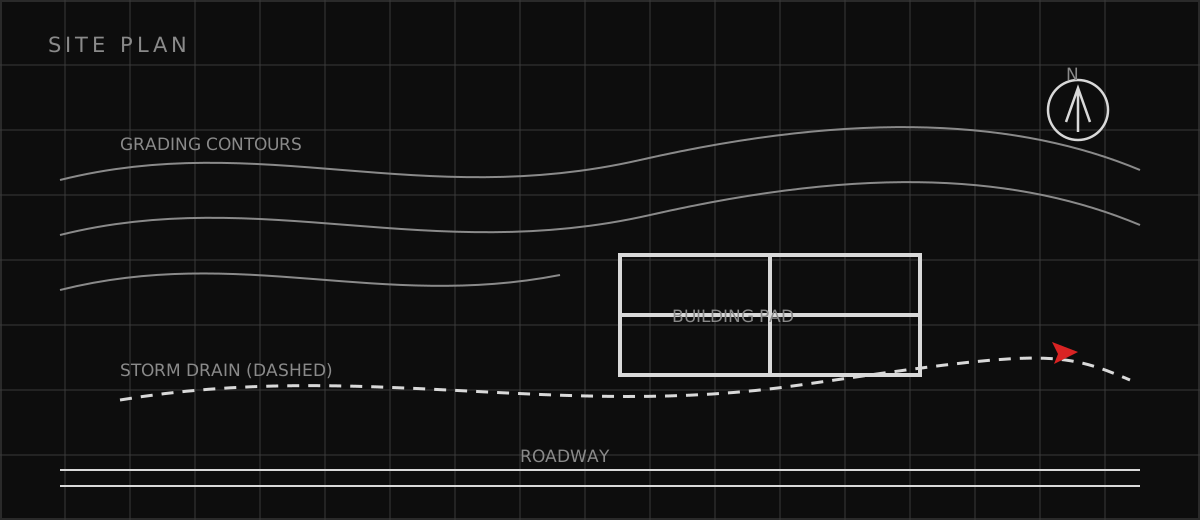
Hydrology: Sizing the Storage
Detention sizing is a math problem with regulatory answers. The engineer builds a hydrologic model of the site using the methods the city's criteria specify — typically SCS or rational-method hydrographs depending on watershed size — and runs the full suite of design storms. For each storm, the model produces an inflow hydrograph to the detention facility, and the engineer routes it through the proposed storage with the outlet structure's rating curve to prove the outflow peak stays at or below the pre-development peak. The required storage volume is whatever the routing says it is; there is no shortcut around the calculation. Water quality rides along with quantity in San Antonio. The city's criteria and, on the recharge zone, the TCEQ rules require treatment of the first flush of runoff — the dirtiest water, carrying oils, sediments, and debris off the new pavement. The engineer integrates extended-detention outlets, biofiltration, or proprietary treatment devices with the flood-control volume, sometimes in the same basin with a multi-stage outlet. The design must satisfy both the peak-rate control for flooding and the volume-based treatment for water quality, and the calculations document each independently for the reviewer.
Outlets, Overflows, and Long-Term Maintenance
The outlet structure is where detention succeeds or fails. The engineer sizes orifices and weirs for the controlled release rates, protects them with trash racks and sediment forebays so they do not clog, and sets the basin's permanent pool or dry bottom to drain within the required drawdown time — a basin that stays full breeds mosquitoes and loses its storage for the next storm. Access ramps or manholes let maintenance crews reach every part of the system, because an underground vault nobody can enter is a vault nobody cleans. The emergency overflow handles the storm bigger than the design event. The engineer sets an overflow weir or spillway that passes the extreme flood without overtopping the embankment or flooding the building, and the downstream path of that overflow is kept clear by easement. Maintenance is a legal obligation, not a suggestion: the owner or HOA maintains the system under a recorded maintenance agreement, and the city can enforce it. The engineer's plans show the maintenance access, the sediment removal provisions, and the easements, so the system the reviewer approved is the system that can actually be kept working.
Which related engineering resources can help?
What else do project teams ask?
What is the difference between detention and retention?
Why must post-development runoff not exceed pre-development rates?
What happens if a site is in a FEMA floodplain?
Who reviews detention design in San Antonio versus Bexar County?
Ready to discuss your engineering scope?
Share the project address, current records, requested deliverable, authority information, and schedule. Apex Grid confirms professional responsibility, availability, and scope before work begins.
Request a Project Review