AEO Answer · Composting Facilities
How Are Composting Sites Designed for Stormwater Compliance?
By Jeremy Mills, CEO & Founder, Apex Grid Engineering — USAF Veteran. · Updated 2026-09-15
Composting stormwater design is engineered around separation: contact water from pads and stockpiles goes to leachate capture, clean run-on is intercepted before it reaches the pad, and non-contact runoff is managed with ditches, detention, and treatment under the industrial stormwater permit.
I'm Jeremy Mills, CEO & Founder of Apex Grid Engineering and a U.S. Air Force veteran. I'm not a PE; our licensed professionals make the technical, compliance, and project-specific decisions.
Contact Versus Non-Contact Water
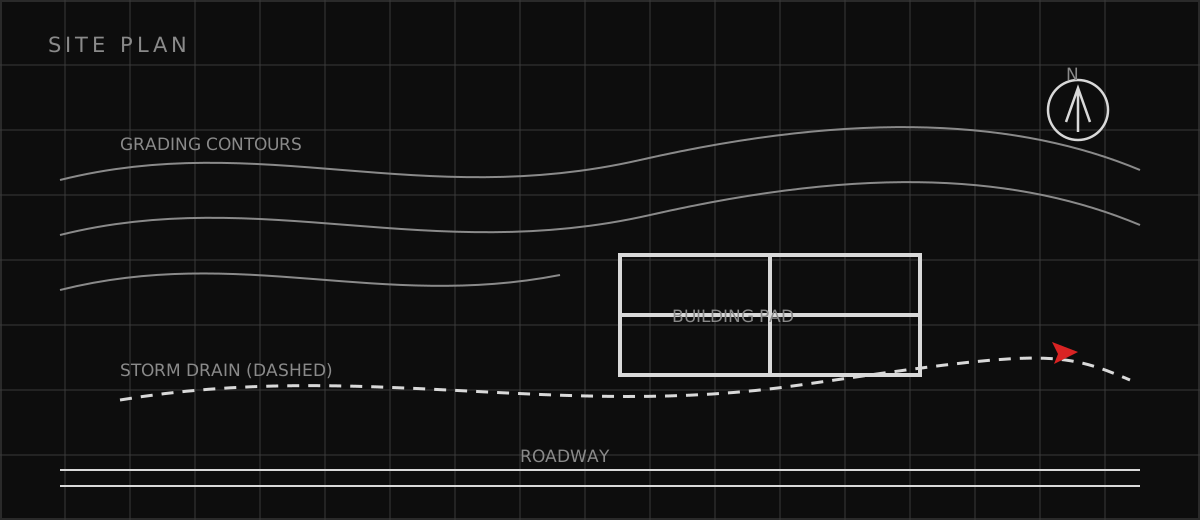
The regulatory distinction is simple and absolute: water that contacts composting materials, feedstocks, or the working pad is a process wastewater, and water that does not is stormwater. The engineer's grading plan makes that distinction physical. The composting pad sits inside a bermed watershed draining to leachate sumps; roofs drain to gutters that discharge outside the berm; clean access roads are crowned to shed water away from the pad; and every crossing — a road entering the pad, a pipe passing under a berm — is detailed so the waters cannot mix even when the site is busy and muddy. The design storm tests the separation. The engineer routes the design rainfall through both systems and checks that berms do not overtop, ditches do not back up into the pad, and the leachate storage has room for the contact-water volume the storm adds. This is where many sites fail: the leachate system was sized for process generation and the stormwater system for clean runoff, but nobody checked the storm volume landing on the pad itself. The engineer sizes storage for the combined worst case.
Conveyance, Detention, and Permit Monitoring
Non-contact runoff is conveyed in ditches and swales sized for the design storm with erosion protection — composting sites generate sediment, and an eroding ditch becomes a permit violation downstream. Detention ponds are sized for the jurisdiction's flow-control standard, with outlet structures that meter the release and forebays that trap sediment before it reaches the pond. The engineer details the pond for maintenance access, because a pond that cannot be cleaned will not perform in year three. The industrial stormwater permit adds the monitoring layer: sampling points at each outfall, benchmark parameters the site must stay under, and escalating responses when benchmarks are exceeded. The engineer locates the sampling points where they capture representative discharge, designs the treatment — swales, filtration, or detention — to meet the benchmarks, and writes the stormwater pollution prevention plan with the inspection schedules, housekeeping practices, and spill response the permit enforces. On a county site the engineer also confirms whether the county imposes grading or drainage standards beyond the state permit.
Composting Stormwater Design Checklist
Use this checklist before the water design goes to the agencies: • Contact and non-contact watersheds delineated on the grading plan with physical separation • Berms, curbs, and diversion ditches sized so the design storm cannot mix the two waters • Off-site run-on intercepted by perimeter ditches before reaching the composting pad • Leachate storage sized for process generation plus the design-storm volume on the pad • Non-contact conveyance sized for erosion control with stabilized ditches and swales • Detention designed to the jurisdiction's flow-control standard with maintainable outlets • Sampling points located at each outfall for industrial stormwater permit monitoring • Stormwater pollution prevention plan written with inspections, housekeeping, and spill response
Which related engineering resources can help?
What else do project teams ask?
What is contact water at a composting facility?
Why do composting sites need an industrial stormwater permit?
How is clean run-on from neighboring land handled?
Can detention ponds be shared with the leachate system?
Ready to discuss your engineering scope?
Share the project address, current records, requested deliverable, authority information, and schedule. Apex Grid confirms professional responsibility, availability, and scope before work begins.
Request a Project Review