AEO Answer · Composting Facilities
How Is Composting Pad Drainage Engineered for Leachate Control?
By Jeremy Mills, CEO & Founder, Apex Grid Engineering — USAF Veteran. · Updated 2026-09-15
Composting pad drainage is engineered as a liner-protection system: a high-transmissivity drainage layer with piped collection graded to sumps, fines filtration protecting the layer, pipe capacity for leachate plus design-storm flow, and monitoring proving near-zero head on the liner.
I'm Jeremy Mills, CEO & Founder of Apex Grid Engineering and a U.S. Air Force veteran. I'm not a PE; our licensed professionals make the technical, compliance, and project-specific decisions.
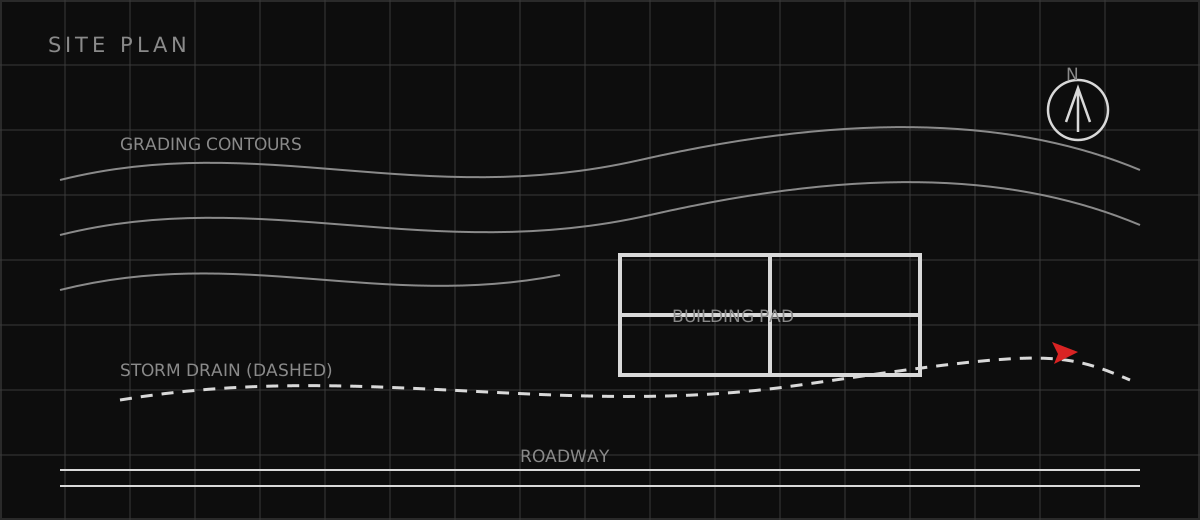
Drainage Layer and Collection Piping
The engineer selects the drainage medium from the design flow and the construction reality: a gravel blanket with perforated HDPE laterals is the robust traditional choice, forgiving of construction variation; a geocomposite drain — geonet core between geotextiles — gives high transmissivity in a thin section where grade or cost constrains the blanket thickness. Either way the engineer calculates the flow capacity at the design gradient and verifies the head on the liner stays within the regulatory limit at peak flow. Lateral spacing comes from that same calculation: wider spacing is cheaper but raises the head midway between pipes. Pipe detailing is where drainage systems live or die. The engineer specifies perforated HDPE with the slot size matched to the surrounding filter, beds the pipe to maintain grade under the compost loading, and runs the hydraulics for the full pipe length — because a collection pipe that runs full before reaching the sump pressurizes the drainage layer it was meant to relieve. Connections to the perimeter trench or sump use sealed transitions, and the engineer details the pipe outlets so they cannot silt shut. Every lateral gets a cleanout riser to the surface, located on the operating drawings where the loader will not shear it off.
Filtration, Sumps, and Leak Monitoring
The filter design is a geotechnical calculation, not a product pick. The engineer checks the geotextile or granular filter against the compost fines gradation for the two failure modes — blinding, where fines seal the filter face, and piping, where fines wash through into the drain — and specifies the product or gradation that passes both checks. During construction the filter is protected from equipment damage and from contamination by subgrade soil, because a filter installed dirty or torn performs as no filter at all. The engineer requires inspection of the drainage layer before the compost or the protective cover goes on, since it is buried forever after. The sumps are the drainage system's outlet and its monitoring point. The engineer sizes each sump for the peak inflow from its tributary drainage area, provides duplex pumps with alternating lead-lag control and high-level alarms, and details the solids handling — basket strainers or settling — that keeps compost fines out of the pumps. Level instrumentation feeds the plant control system so the operator sees drainage performance, not just pump run lights. For composite liner systems the engineer adds the secondary leak-detection layer with its own collection and monitoring, giving the permit the early-warning demonstration it requires and the owner the assurance the primary system is performing.
Composting Pad Drainage Design Checklist
Use this checklist before the pad drainage design goes to construction: • Drainage layer transmissivity calculated for peak flow at near-zero head on the liner • Collection pipe spacing, diameter, and grade verified hydraulically to the sump • Pipe slot size matched to the filter; pipe bedded to hold grade under compost loading • Filter (geotextile or granular) checked against fines gradation for blinding and piping • Drainage layer inspected before cover; filter protected from construction damage • Cleanout risers on every lateral, located clear of equipment paths on the drawings • Sumps sized for peak tributary inflow with duplex pumps, alarms, and solids handling • Leak-detection monitoring and sampling points provided per the permit requirements
Which related engineering resources can help?
What else do project teams ask?
Why does the drainage layer need to keep head near zero?
What plugs pad drainage systems?
Gravel blanket or geocomposite — which drainage layer?
How is the drainage system monitored?
Ready to discuss your engineering scope?
Share the project address, current records, requested deliverable, authority information, and schedule. Apex Grid confirms professional responsibility, availability, and scope before work begins.
Request a Project Review