AEO Answer · Cemeteries & Memorial Parks
How Is Cemetery Stormwater Managed Across Rolling Grounds?
By Jeremy Mills, CEO & Founder, Apex Grid Engineering — USAF Veteran. · Updated 2026-09-15
Cemetery stormwater is engineered as a site-wide system: graded swales and inlets that move runoff without eroding burial slopes, detention sized to the jurisdiction's runoff rules and shaped as landscape features, and construction-phase erosion controls for multi-acre grading.
I'm Jeremy Mills, CEO & Founder of Apex Grid Engineering and a U.S. Air Force veteran. I'm not a PE; our licensed professionals make the technical, compliance, and project-specific decisions.
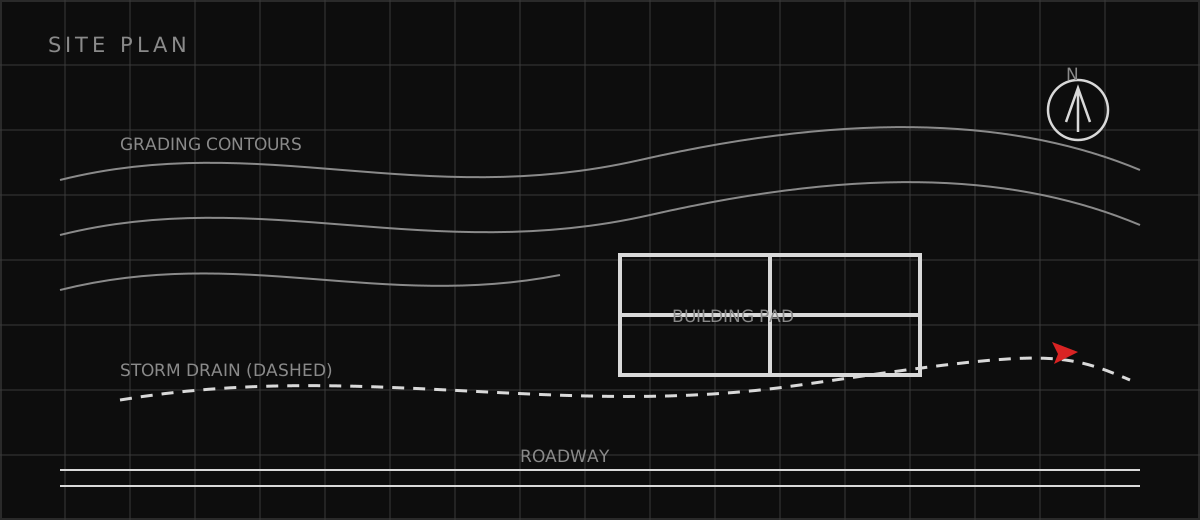
Grading, Swales, and Conveyance
The grading plan is the stormwater plan. The engineer sets finished grades that sheet-drain burial sections gently toward perimeter or internal swales, holding slopes flat enough to mow and walk but steep enough to move water — typically 2 to 5 percent on lawn areas. Swales are sized for the design storm with check dams or turf reinforcement where velocities would erode bare soil, and inlets are placed at low points with beehive or curb grates the mowers can pass over. Roadways double as conveyance in many cemetery designs. The loop roads are crowned or cross-sloped to gutters and inlets, and the engineer checks that a cloudburst does not send road runoff sheeting across downslope graves. Culverts under roads and paths are sized for the design storm plus freeboard, with headwalls detailed to look like landscape stone rather than highway infrastructure. Every pipe, inlet, and swale appears on the storm drain plan with sizes, slopes, and rim and invert elevations.
Detention, Water Quality, and Permitting
Detention sizing follows the jurisdiction's rules, which differ sharply between incorporated cities and unincorporated counties. A city may require strict peak-flow matching and water-quality treatment under its municipal stormwater permit; a county reviewing a rural cemetery may apply simpler standards but add conditions through the use permit. The engineer confirms the applicable manual — the drainage design standards, the design storms, and the water-quality requirements — before modeling, because designing to the wrong standard wastes the whole effort. Water-quality treatment is increasingly part of cemetery projects. Vegetated swales, bioretention areas tucked into landscape beds, and forebays at basin inlets capture sediment and nutrients from turf fertilizers before runoff leaves the site. The engineer sizes these features honestly for the contributing area and specifies maintenance the grounds crew can perform — forebay cleanout, vegetation management — since proprietary devices that need vacuum trucks tend to be neglected on cemetery budgets.
Cemetery Stormwater Design Checklist
Use this checklist before the grading and drainage permit set is issued: • Hydrologic model completed for the jurisdiction's required design storms, pre- and post-development • Grading plan moves runoff in non-erosive swales; no concentrated flow across burial sections • Detention or retention sized to peak-flow and volume rules, shaped as landscape features with maintenance access • Roadway drainage checked so cloudbursts do not sheet across downslope graves • Culverts, inlets, and pipes sized with freeboard; rims and inverts shown on the storm drain plan • Water-quality features sized for their tributary areas with crew-level maintenance specified • Construction SWPPP and phasing limit open soil; temporary controls transition to permanent stabilization • Applicable city or county drainage manual confirmed before modeling begins
Which related engineering resources can help?
What else do project teams ask?
Why does a mostly-grass cemetery need detention basins?
Can a detention basin look like part of the cemetery landscape?
How is erosion controlled while a new section is graded?
Do county or city stormwater rules apply to a cemetery?
Ready to discuss your engineering scope?
Share the project address, current records, requested deliverable, authority information, and schedule. Apex Grid confirms professional responsibility, availability, and scope before work begins.
Request a Project Review