AEO Answer · Car Rental Facilities
How Is Paint Booth Ventilation Engineered for Body Shops?
By Jeremy Mills, CEO & Founder, Apex Grid Engineering — USAF Veteran. · Updated 2026-09-15
Paint booth ventilation is engineered as balanced high-air-change supply and exhaust — downdraft preferred — with multi-stage intake and exhaust filtration, heated air for spray and bake cycles, classified-area electrical, and interlocks that stop spraying if ventilation fails.
I'm Jeremy Mills, CEO & Founder of Apex Grid Engineering and a U.S. Air Force veteran. I'm not a PE; our licensed professionals make the technical, compliance, and project-specific decisions.
Balancing supply, exhaust, and the building
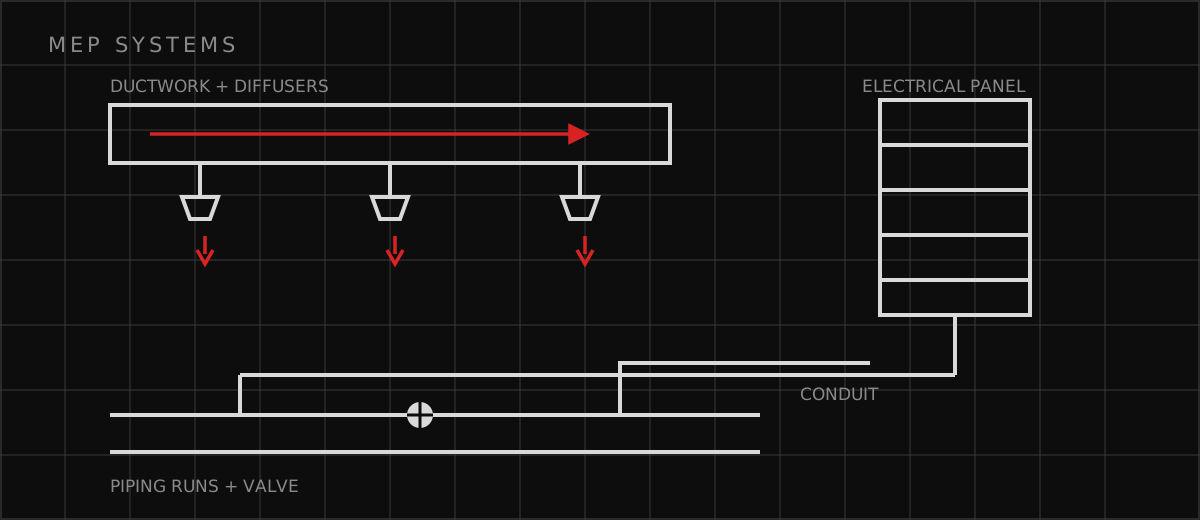
A paint booth moves an enormous amount of air, and the building has to absorb it. I design the booth's dedicated makeup air unit to match the exhaust exactly, so the booth stays near neutral to the shop — otherwise the booth steals air from the building and the overhead doors become hard to open. The bake-cycle heating load is calculated for the full airflow at the bake temperature rise, which usually means a dedicated direct-fired or indirect-fired heater. The ductwork is sized for low velocity to keep noise down and the fan selected for the filter-loaded static pressure, not just the clean-filter number. Balance is verified at commissioning with the filters at mid-life loading.
Filtration, stacks, and environmental compliance
The exhaust side ends at the stack, and the stack design follows the code for height, termination, and dispersion away from intakes and property lines. The filtration stages are specified with their arrestance ratings and the pressure-drop budget the fan is built for. Environmental compliance — air-quality permits for the coating operation — is confirmed with the local air district before the design is finalized, because some jurisdictions require add-on controls like carbon adsorption for the solvent load. The permit determines the exhaust treatment, so the permit work starts early and the engineering follows it.
Paint booth ventilation checklist
A paint booth ventilation design is ready when it clears this checklist. The finish and the painter's lungs both depend on it. • Booth type selected for the quality target; airflow pattern proven with velocity measurements • Balanced supply and exhaust with dedicated makeup air; booth neutral to the shop • Heating plant sized for the bake cycle at full airflow; controls sequencing spray, flash, bake • Multi-stage intake and exhaust filtration with monitored change-out schedule • Classified-area electrical, ventilation-failure interlocks, and code-compliant stack design
Which related engineering resources can help?
What else do project teams ask?
Why is downdraft better than crossdraft for paint booths?
What temperatures does a paint booth need?
How is overspray kept out of the exhaust system?
What electrical classification applies inside a paint booth?
Ready to discuss your engineering scope?
Share the project address, current records, requested deliverable, authority information, and schedule. Apex Grid confirms professional responsibility, availability, and scope before work begins.
Request a Project Review