AEO Answer · Campgrounds & RV Resorts
What Does Stormwater Engineering Look Like for Campgrounds?
By Jeremy Mills, CEO & Founder, Apex Grid Engineering — USAF Veteran. · Updated 2026-09-15
Campground stormwater engineering models pre- and post-development hydrology, then designs erosion-proof conveyance — swales, ditches, culverts with stabilized outlets — plus detention that releases runoff at natural rates and water-quality features like forebays, all maintainable by park staff and integrated into the landscape.
I'm Jeremy Mills, CEO & Founder of Apex Grid Engineering and a U.S. Air Force veteran. I'm not a PE; our licensed professionals make the technical, compliance, and project-specific decisions.
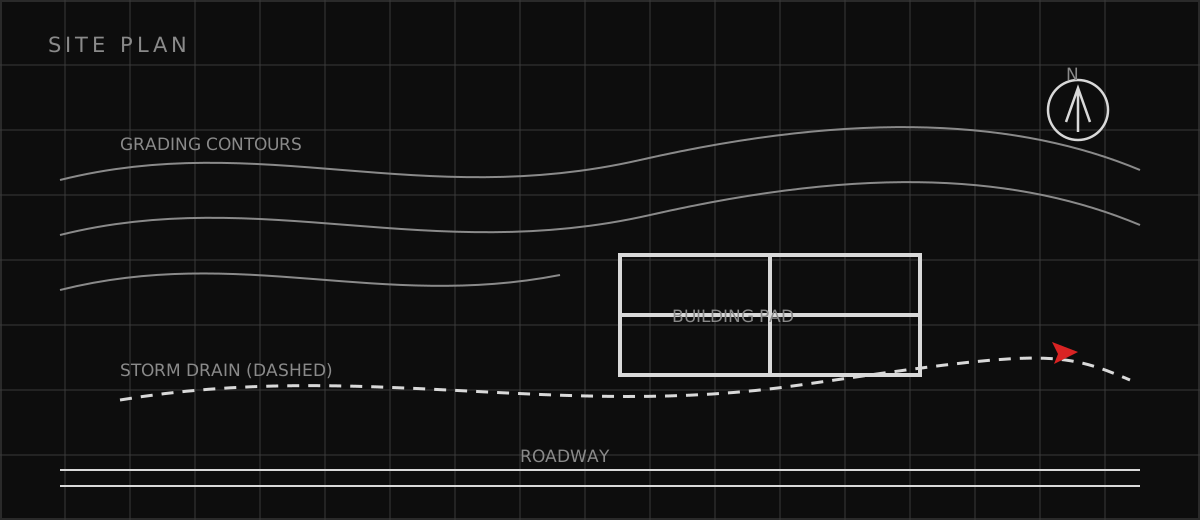
Hydrology: before and after
The hydrologic model is the design's foundation. I delineate the drainage areas, assign runoff characteristics honestly — compacted campground soils shed far more water than the meadow they replaced — and run the required design storms for both the existing and developed conditions. The results size everything downstream: conveyance, detention volume, outlet structures. I also check the downstream impacts, because increasing peak flows onto a neighbor's property or a sensitive stream is both a regulatory violation and a good way to make enemies. The model gets revisited if the site plan changes significantly — grading revisions that nobody re-models are a classic source of stormwater failures.
Conveyance, detention, and water quality
I design the conveyance network to move water without destroying the site: vegetated swales where slopes allow, riprap or turf reinforcement where water moves fast, culverts sized by calculation at every crossing, and stabilized outlets that dissipate energy before water enters natural channels. Detention goes where the hydrology says it must, shaped to fit the landscape and the site plan. Water quality features — sediment forebays at basin inlets, vegetated filter strips along swales — get sized per the regulations and detailed for maintenance. I keep the whole system gravity-driven wherever possible; pumps in stormwater systems are maintenance liabilities.
Checklist for water that behaves
I verify the stormwater design against the model one more time before construction, then inspect the critical elements as they're built: outlet structures, basin grading, culvert installations. After the first real storm, I walk the system with the maintenance team — that walkthrough teaches more than any drawing. The owner gets the maintenance plan, the as-built grading, and the outlet settings documented. Erosion control stays in place until vegetation is established, not until the contractor wants to demobilize. Here is the checklist I hand campground developers.
- Model pre- and post-development hydrology with honest runoff coefficients for compacted areas
- Design conveyance — swales, ditches, culverts — to carry design storms without eroding
- Size detention to release at pre-development rates with emergency overflow for extreme events
- Integrate basins into the landscape and detail every element for staff-level maintenance
- Walk the system after the first real storm and keep erosion control until vegetation holds
Which related engineering resources can help?
What else do project teams ask?
How is runoff calculated for a campground?
What does detention look like at a campground?
How is erosion controlled during campground construction?
Who maintains a campground stormwater system?
Ready to discuss your engineering scope?
Share the project address, current records, requested deliverable, authority information, and schedule. Apex Grid confirms professional responsibility, availability, and scope before work begins.
Request a Project Review