AEO Answer · Breweries & Distilleries
How Is Process Piping Designed for a Brewery Production Floor?
By Jeremy Mills, CEO & Founder, Apex Grid Engineering — USAF Veteran. · Updated 2026-09-15
Brewery process piping uses segregated sanitary stainless systems for product contact — sloped to drain, free of dead legs, CIP-compatible — with each utility on properly rated, labeled piping routed for service access and expansion.
I'm Jeremy Mills, CEO & Founder of Apex Grid Engineering and a U.S. Air Force veteran. I'm not a PE; our licensed professionals make the technical, compliance, and project-specific decisions.
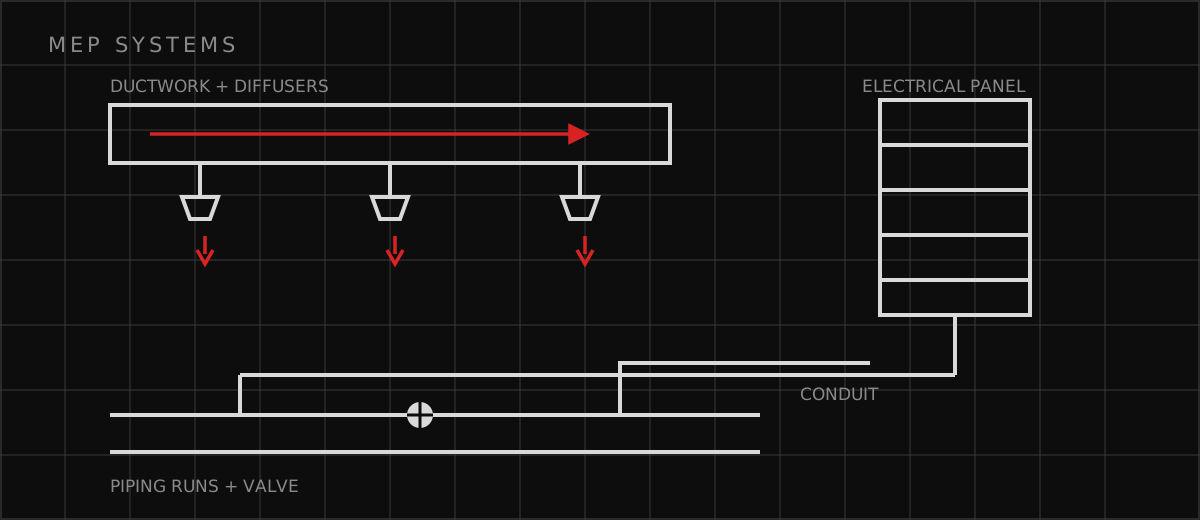
Sanitary product piping, end to end
Product piping starts at the brewhouse outlet and does not stop being sanitary until the beer is in the package. I lay out the wort, beer, and transfer lines for the shortest practical runs with continuous slope to drain points, sanitary valves at every branch, and sample valves placed where they can actually be used without contaminating the line. Weld quality gets specified and inspected — purge-welded, smooth interior, documented — because a sugared weld inside a beer line is a permanent cleaning problem. Expansion and flexibility are designed in, since hot wort and cold beer cycle the same lines through wide temperature swings, and hangers keep everything supported without creating dirt-collecting horizontal surfaces.
Utility networks with brewery discipline
Each utility gets its own engineered network. Steam and condensate run in rated steel with traps and proper pitch back to the boiler. Glycol supply and return are insulated, balanced so every tank gets design flow, and valved for isolation. Compressed air distribution includes dryers and filtration staged so food-contact air meets the purity the process needs. Water lines serving the brewhouse get treatment and backflow protection appropriate to the hazard. Chemical lines for CIP get secondary containment thinking and materials rated for caustic and acid. I route all of them overhead or in protected chases, labeled and accessible, because a utility network the crew cannot service is a network that quietly degrades.
Brewery process piping design checklist
This checklist follows the beer from brewhouse to package. Every item protects either product quality or the crew. • Food-grade stainless product piping with sanitary welds, smooth interior finish, and clamp fittings for inspection • Continuous slope to drain points on every product line, with no un-drainable low spots • Dead legs eliminated or shortened to lengths CIP flow can actually scour • Segregated utility networks — steam, glycol, air, water, chemicals — each on properly rated piping • Distinct fittings, color coding, and tagging so cross-connection is difficult, not just discouraged • Hangers, expansion loops, and routing that keep lines protected, accessible, and documented in as-builts
Which related engineering resources can help?
What else do project teams ask?
What pipe material is used for beer product lines?
What is a dead leg and why does it matter in a brewery?
How does clean-in-place compatibility shape piping design?
How are brewery utility lines kept from being cross-connected?
Ready to discuss your engineering scope?
Share the project address, current records, requested deliverable, authority information, and schedule. Apex Grid confirms professional responsibility, availability, and scope before work begins.
Request a Project Review